Download The Highlands of Scotland in 1750: From Manuscript 104 in the King's Library, British Museum; With an Introduction (Classic Reprint) - Andrew Lang | PDF
Related searches:
The Highlands of Scotland in 1750: From Manuscript 104 in the
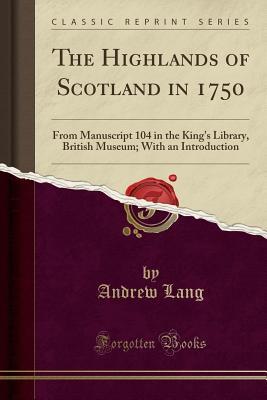
The Highlands of Scotland in 1750: From Manuscript 104 in the King's Library, British Museum; With an Introduction (Classic Reprint)
The Highlands of Scotland in 1750: Bruce: Amazon.com: Books
Cultural Perceptions of the Scottish Highlands in - JSTOR
Where Did All the Highlanders Go? – The Simply Scottish Blog
The Highland Clearances - The Scottish History Society
The Highland myth as an invented tradition of 18th and 19th - GRIN
The myths of Bonnie Prince Charlie and the Jacobites - BBC News
The Highlands of Scotland in 1750 : Bruce, Andrew Lang : Free
The Highlands of Scotland in 1750. From manuscript 104 in
Full text of The Highlands of Scotland in 1750
The Highland Emigration of 1770 - Electric Scotland
How Profits From Slavery Changed the Landscape of the Scottish
A HISTORY of the SCOTTISH PEOPLE MIGRATION - Scran
The Highland Clearances Scottish History Highland Titles
The Highlands of Scotland in 1750 (Classic Reprint): Andrew
The impact of the military profession on Highland gentry families, c
Книга The Highlands of Scotland in 1750 – купить книгу ISBN 978
Highland Drovers - The Doric Columns
The 'Great Highland Myth' and Post-War Scottish Countryside Policy
Highland Targe Scottish The Metropolitan Museum of Art
Amazon.com: The Highlands Of Scotland In 1750 (1898
The Royal Colony of North Carolina - The Highland Scots Settlers
The Living Conditions in the Highlands after 1745 - Part 1
The Scottish Highland Regiments in the French and Indian War
The Highland Clearances: Reading History and Dispossession
Accents and dialects of Scotland - The British Library
Landscapes of Protest in the Scottish Highlands after 1914: The Later
Scottish Enlightenment - The History of Economic Thought Website
Highland Women's Clothing in the Mid-18th Century Culloden
Mistress of Disguise: Scottish Dress in the 18th Century - A Question
The Highland Clearances - Scottish History Society
The Dark Side of the Scottish Highlands Adventurous Kate
Scottish Highlands - Infogalactic: the planetary knowledge core
The Highland margin of Scotland, c. 1770–1860 SpringerLink
Clans of the Scottish Highlands and Lowlands Map - PlanetWare
Livestock Production in the Scottish Highlands Before and
50 of the Most Significant events from 1750-1901 timeline
Where are the Highlands? – The Highland Clearances
From the Caribbean to the Scottish Highlands: Charitable
64 4801 2825 412 744 2155 2601 1424 382 1729
In consequence of the famine of 1740-41 it is stated that for several years afterward 12,000 emigrants annually left ulster for the american plantations’’ while from 1771 to 1773 ‘‘the whole emigration from ulster is estimated at 30,000, of whom.
Clans were generally associated with a geographical area of scotland, for example, the armstrong clan originated in the borders, the macgregors in argyll, and clan campbell ruled the roost across much of the scottish highlands. Clans often had ancestral castles too, such as clan murray’s duffus castle in blair atholl.
Sep 20, 2019 although we think of the period of the highland clearances being from 1750 to 1860, lets think back to the 1600s.
The dividing line was everything west from the great glen (inverness to loch linnhe and the islands) and roughly 50 miles of land east of the great glen.
Aug 6, 2013 since as far back as the 12th century, families in scotland were organized into networks, called clans.
1750 - james dorret - a general map of scotland and islands thereto belonging 1751 - james dorret - [north] a correct map of scotland from new surveys.
Highland targes were the last type of european shields to be used actively.
The highland economy, 1750–1850 (edinburgh, 1957) humphreys, rob, and donald reid. Collins encyclopaedia of scotland (1994) kermack, william ramsay.
The belted plaid or the breacan-an-feileadh (pr: bre-kan an feelay)��� the great kilt, appears to have been the characteristic dress of the highlander from the late.
Staging rebellions in scotland in 1715, 1719 and 1745, they attempted to overthrow the ruling quaich wooden highland bowl or drinking vessel used by a jacobite soldier of the 1715 rising william augustus, duke of cumberland, 1750.
Scotland lost 10% to 47% of the natural population increase every decade in the 1800s. Until about 1855, a number of the emigrants from the highlands were.
The highlands of scotland in 1750 from manuscript 104 in the kings ubrary, british museum with an introduction bt andrew lang william blackwood sons edinburgh and london mdccc xcvin� (typographical errors above are due to ocr software and don't occur in the book. ) about the publisher forgotten books is a publisher of historical writings.
He sailed from france to scotland, arriving on eriskay in the outer hebrides in july 1745 and then travelled across the highlands, to assemble a jacobite army. This venture ended in the battle of culloden in 1745 whereby the scottish army was defeated in what is probably the worst event to have ever overtaken scotland.
Trews were worn in scotland from the medieval period through the end of the 18th century, usually by men wealthy enough to own and/or ride horses. They are descended either from early celtic braccae/broc, or from footed hose common throughout europe in the middle ages and worn elsewhere in the british isles through the 17th century for casual.
Nearly all the detailed maps of parts of scotland up to 1750 are derived from the work of three main mapmakers: timothy pont in the late 16th century, robert.
As in wales, an ethnic celtic language exists alongside english – in this case scottish gaelic.
Only a few localities are included and the time period varies by locality.
For most of the eighteenth century the british officer class was dispro- portionately drawn from the scottish gentry.
Map of the highlands of scotland denoting the districts or counties inhabited by the highland clans. Lizars, william home, 1788-1859 scotland, drawn from a series of angles and astronomical observations.
Highland clearances, the forced eviction of inhabitants of the highlands and western islands of scotland, beginning in the mid-to-late 18th century and continuing intermittently into the mid-19th century. The removals cleared the land of people primarily to allow for the introduction of sheep pastoralism.
As the years passed thousands of people crossed the atlantic from ulster, just as their ancestors had crossed the north channel from scotland a century or more before. However, by 1750 the pace of migration began to slow, as relatively normal conditions returned to ulster after years of economic dislocation.
Craigellachie is a small village that goes back to 1750's and is situated in the middle of speyside in the highlands of scotland. The name of the town means rocky hill which describes its location well, as craigellachie can be found situated on and around two river valleys.
8 march – king william ii of scotland (william iii of england and ireland) dies and is succeeded by queen anne on the english, scottish and irish thrones. Parliament of scotland passes the act of security 1704 in response to the parliament of england's act of settlement 1701.
Before the introduction of civil registration in 1855 church of scotland parish ministers and session clerks kept registers of births and baptisms, proclamations of banns and marriages, and deaths and burials.
In scotland, ancient woodland is defined as land that is currently wooded and has been continually wooded since at least 1750. The wildlife communities, soils and structure of ancient woodlands have had the longest time to develop.
Full text of the highlands of scotland in 1750 see other formats.
Lobban, 'the migration of� highlanders into lowland scotland 1750-1890' (unpublished.
Between 1750 and 1850, over 25000 scots were forced from their homes in the highlands of scotland by landowners wanting to enclose the land. These farmers were left homelessand without the ability to grow their own food.
1750-1780: agricultural change and 'improvement' in a british context. Although often associated with resistance to change or 'progress', the scottish highlands.
The highlands and the roots of green consciousness, 1750-1990 (inverness: scottish natural heritage, 1990).
В наличии книга the highlands of scotland in 1750, книга по требованию в интернет-магазине ozon со скидкой! ✓ отзывы и фото быстрая.
May 19, 2014 balfe described her costumes for the freshman 16-episode series, which finishes filming its second season in scotland in august, as ranging from.
Roughly speaking, the phase referred to may be said to have lasted from 1740 to 1775. 1784) suggests 1763 as the earliest date, but there are several reasons r putting it earlier. Pennant in his travels gives 1750 as the starting-point for skye.
Scottish clans (from scottish gaelic clann, children), give a sense of identity and shared descent to people in scotland and to their relations throughout the world,.
The highlands of scotland in 1750: from manuscript 104 in the king’s library, british museum.
After 1750, emigration brokers and ambitious colonial land speculators frequented the northwest coast of scotland to procure highland emigrants. The brokers and speculators recognized that the poor but tough highlanders were especially well-prepared for the rigors of a transatlantic passage and colonial settlement.
I know this is a very negative post — far more so than usual. But the highlands were one of the most thought-provoking places i’ve visited in a very long time, with or without the family connection.
Are worthy of study because they represented a departure from long established military and political policies and were the proto-type of a large number of scottish.
But are these landmarks really linked to a tradition from times immemorial? do they really represent a link to scotland's gaelic roots? this paper will investigate.
The internal structure of scotland was also quite different from england. The edinburgh parliament was an incredibly corrupt and unrepresentative institution.
Title: the highlands of scotland in 1750 author: bruce, andrew lang.
1750-1780: agricultural change and ‘improvement’ in a british context although often associated with resistance to change or ‘progress’, the scottish highlands had experienced revolutionary change in the eighteenth century.
The ancestral home of clan davidson is in the invernahaven area of scotland at the confluence of the spey and tay rivers. The clan lived in this area till around 1400 and maybe even later.
From the 1780s to the 1820s the highlanders were forcibly evicted from their homes. The highland families were often forced into the coastal lands of scotland, which were barren, or to other barren lands.
Most movement was for harvest work but military and naval employment increased temporary movement south from the scottish highlands in the late eighteenth.
Jun 23, 2017 he was resolved to reclaim the thrones of scotland, england and he even converted to anglicanism during a clandestine visit to london in 1750. The highlands, where the clan chiefs' old oaths were to the scotti.
In 1750 they were largely english-speaking, but subsequently they received so many refugees from the clearances further west that gaelic was widely heard there as well. Besides that, the shire of cromarty (including these two parishes) had been considered for so long as an integral part of the highlands that it would seem provocative to exclude.
Unable to defeat the caledonians and picts, the romans eventually withdrew and over time retreated away from britain.
He goes on to build 900 miles of roads and 120 bridges, as well as the caledonian canal and various harbours. 1801: the first gaelic language version of the bible is published.
Post Your Comments: